Free template
Documentation is the work everyone agrees is important and almost no one keeps current. It scatters across wikis, code comments, chat threads, and the memory of whoever happened to build the thing — and that person is, sooner or later, on vacation or gone.
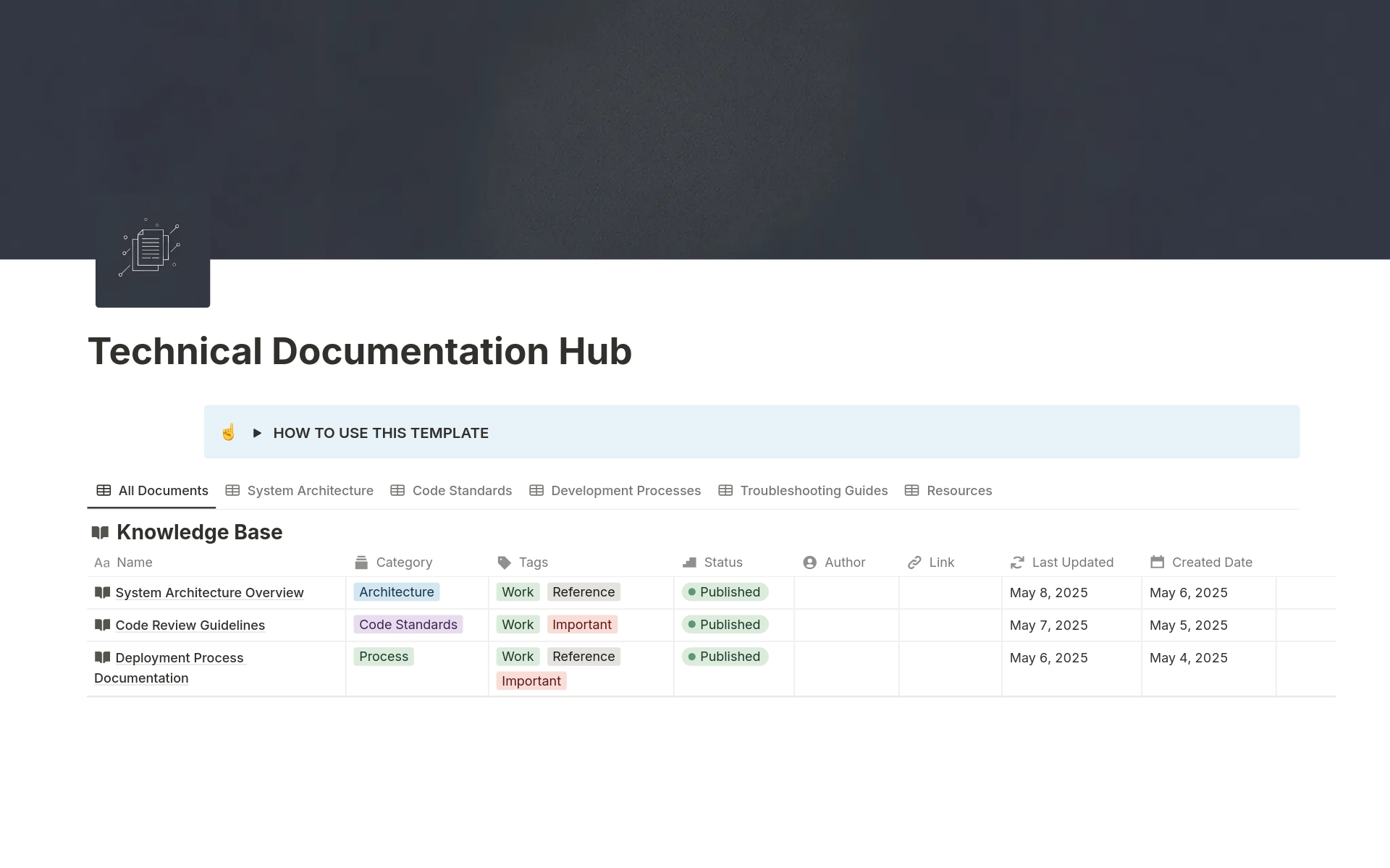
Technical Documentation Hub gives a team’s technical knowledge a single, structured home, built around one well-organized knowledge base rather than a sprawl of half-maintained pages.
The problem it addresses
Undocumented knowledge is a tax a team pays without seeing the bill. The same questions get answered repeatedly. Onboarding takes weeks longer than it should. A single engineer becomes the only person who understands a critical system, and the team’s resilience quietly narrows to one point of failure.
The deeper issue is that most documentation tools make documentation feel like a separate, thankless chore. So it gets deferred, then it goes stale, and stale documentation is arguably worse than none — it misleads with confidence.
What’s inside
- A central Knowledge Base that holds every kind of technical document in one searchable place.
- Specialized views that slice the same content by purpose — system architecture, code standards, development processes, troubleshooting guides, and resources — so people find what they need without wading through what they do not.
- A tagging and categorization system that keeps documents appearing in the right views automatically as the base grows.
- A simple, repeatable workflow for adding, organizing, and maintaining entries, with cross-referencing between related documents.
It is built to be customized — add or reshape views to match how your particular team actually works.
Who it’s for
Engineering teams, technical leads, and solo developers who have felt the cost of knowledge living only in people’s heads. It suits growing teams especially, where the informal “just ask Sarah” approach has started to break down and onboarding has become painful.
It does not write your documentation or keep it fresh on its own. It removes the structural excuses — the scattering, the disorganization, the not knowing where things go — that usually stop documentation from happening.
A closing thought
There is a tempting belief that good code documents itself, and that writing things down is overhead a fast-moving team cannot afford. The truth tends to reveal itself later, usually at the worst moment — a production incident at 2 a.m., a key person unreachable, a system no one fully understands. Documentation, at its core, protects the team’s future capacity to move quickly and safely; the record of the past is almost a side effect. A structured home for that knowledge is a small, deliberate investment against a cost that otherwise arrives unannounced. That protection is what this hub is built to provide.