Free template
Weeks have a way of dissolving. We move through them at speed, solving what is in front of us, and rarely stop to ask what the week actually taught us. So the same mistakes recur, the same good habits lapse unnoticed, and the weeks blur into one undifferentiated rush.
Next Week, But Smarter is a structure for the pause that fixes this. A short weekly review that turns a week’s raw experience into something you can learn from — and use to make the next one better.
The problem it addresses
Experience does not automatically become insight. You can live the same kind of week fifty times and learn very little from it, because learning requires reflection, and reflection is the first thing a busy life crowds out. Without it, you are not accumulating wisdom so much as repeating yourself with new dates attached.
The other gap is between weeks. A week ends and the next begins with no bridge — no carrying forward of what worked, no adjusting for what did not. Each week starts roughly from scratch, which is a strange way to run a life that is supposed to be progressing.
What’s inside
A repeatable weekly review rhythm, structured around a few honest questions:
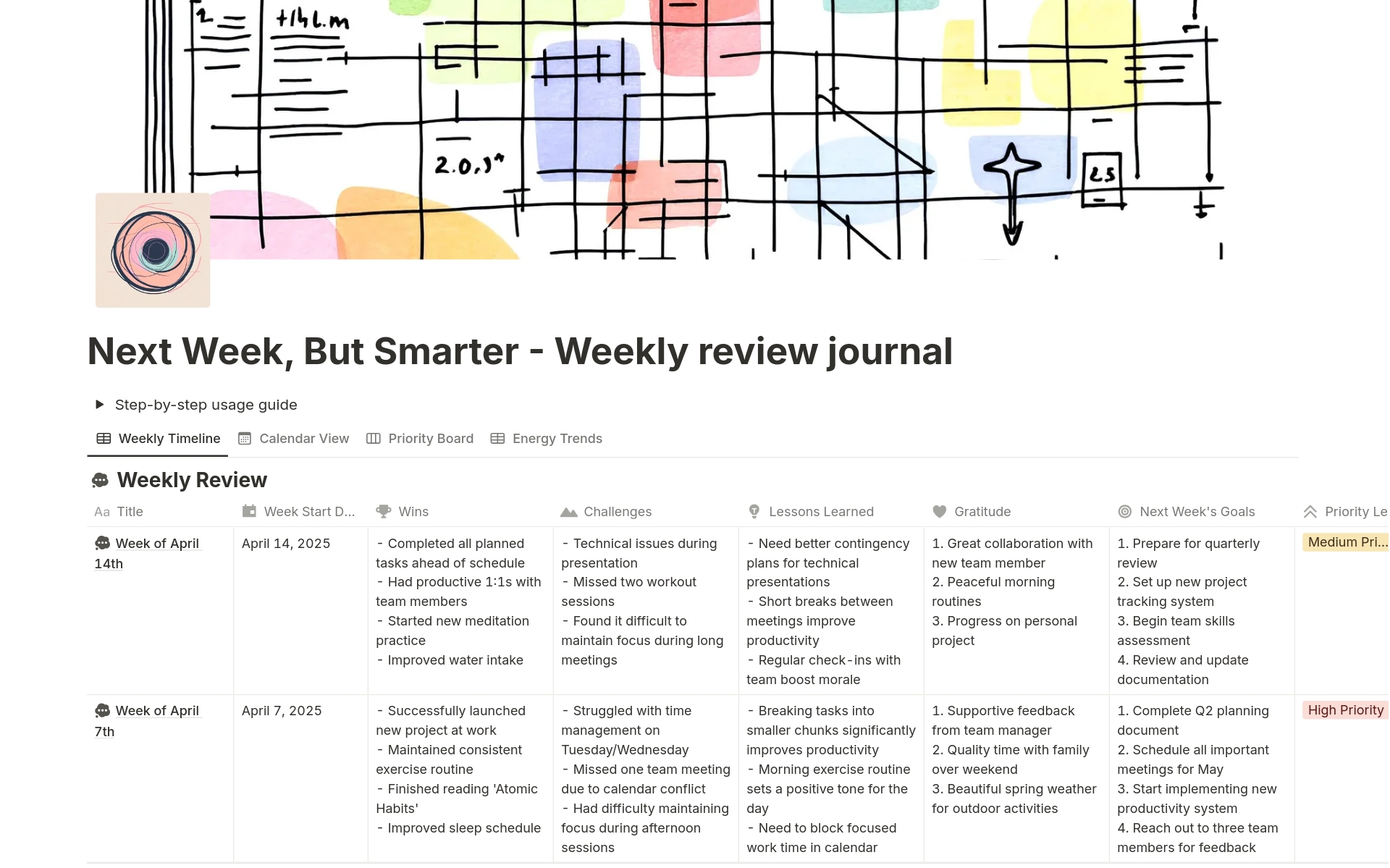
- Wins. What went well — projects finished, habits held — named explicitly, because unacknowledged progress feels like none.
- Challenges. What did not go well and why, and how you responded, so difficulty becomes data rather than just discouragement.
- Gratitude. A few things you are grateful for, a deliberate reset of perspective.
- Planning the next week. Your top three goals and key intentions, so the coming week starts with direction instead of drift.
- Optional tracking of hours, sleep, mood, and the like, for those who want to optimize from real data.
You duplicate the layout each week, building over time a running record of how your weeks — and you — are actually changing.
Who it’s for
People who want their weeks to compound rather than merely pass: anyone who senses they are busy without quite progressing, anyone drawn to reflective practice but lacking a structure to sustain it, anyone who wants to enter each week deliberately rather than reactively. It suits those willing to be honest with themselves on a regular schedule.
Daily task managers work one level down. This is the higher vantage point — the weekly step back that makes the daily effort add up.
A closing thought
There is a compounding effect to reflection that is easy to underestimate. A single weekly review changes little; fifty of them, stacked, quietly reshape how you work, what you tolerate, and where you are heading — because each one feeds the next. The honest half-hour at the end of a week is one of the highest-leverage things you can do with your time, precisely because so few people do it. This journal exists to make that half-hour easy to keep, and to turn the weeks you are already living into weeks you actually learn from.