Free template
A thought is a fragile thing. Most arrive half-formed, get jotted somewhere, and are never seen again, simply because nothing was done to help them grow.
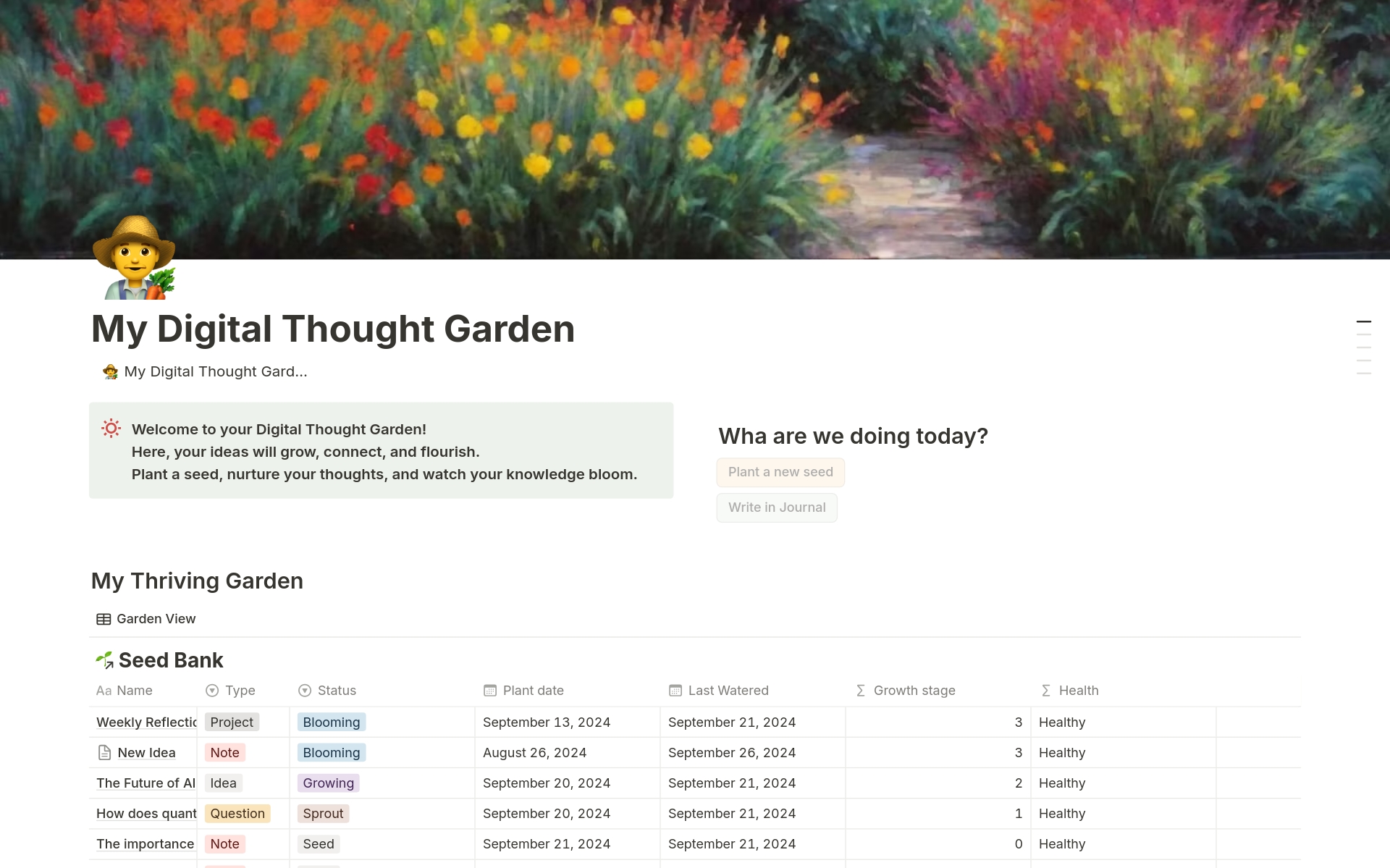
My Digital Thought Garden borrows a gardener’s patience for the life of ideas. You plant a seed, tend it as it develops, and watch the strongest ones bloom — a gentler model than the usual note-taking app, which treats every thought as a finished item to file and forget.
The problem it addresses
Most knowledge systems are built for storage; growth is left to chance. They are good at swallowing notes and bad at making them mature. So ideas go in, lie flat, and never develop — a graveyard dressed up as a library. The metaphor matters: information you merely store stays inert, while ideas you tend tend to connect, deepen, and surprise you.
The other failure is neglect. An idea captured once and never revisited is barely captured at all. Without some prompt to return, the good thoughts wither beside the trivial ones, indistinguishable.
What’s inside
- A Seed Bank for raw, freshly captured ideas — the place a thought lands before it has proven anything.
- Growth stages — recently planted, needs attention, blooming — that let you see at a glance which ideas are developing and which have stalled.
- A watering schedule that surfaces ideas needing revisiting, so promising thoughts are not abandoned to silence.
- A connected workspace where ideas relate to one another, letting a network of thinking take shape rather than a flat list.
The garden framing does real work. It changes how you treat your own ideas — as living things to cultivate rather than items to archive.
Who it’s for
Thinkers, writers, and lifelong learners who want their ideas to develop, not just accumulate: people drawn to the “digital garden” and “second brain” ideas who want a structure that actually encourages tending. It suits those who enjoy returning to their own thoughts and watching them change.
It asks for a little ongoing attention — the watering. A garden no one visits goes to seed, and so does this.
A closing thought
There is a meaningful difference between a mind that hoards information and one that cultivates ideas. The first grows heavier; the second grows richer. Tending a thought — revisiting it, connecting it, letting it change — is how a passing notion becomes genuine understanding, and that process cannot be rushed or automated, only invited. This template is built around that invitation: a patient, living place where your thinking is given the time and care it needs to actually grow into something.