Free template
Standing in front of a painting, most of us run out of things to think after about thirty seconds. We register that we like it, or do not, and move on — a little aware that there was more to see, and no idea how to see it.
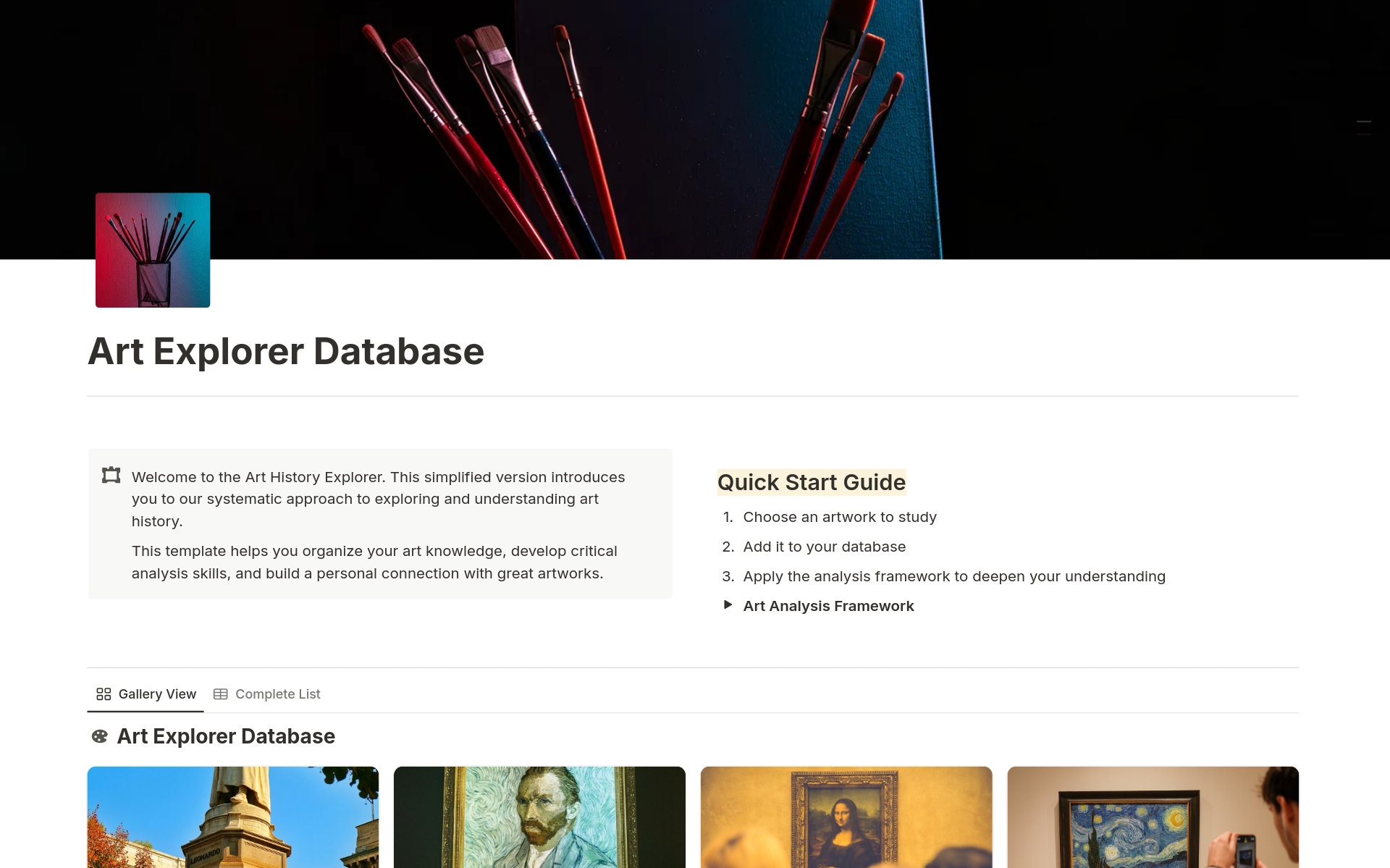
Art Explorer Database is a quiet remedy for that. It gives you a way to study art deliberately, building both a personal collection of works that move you and the habit of looking at them closely.
The problem it addresses
Art rewards attention, but attention needs structure to go anywhere. Without a method, looking stays at the level of taste — nice, not nice — and the richer experience of understanding why a work does what it does stays out of reach. Knowledge gathered from museums, books, and documentaries also tends to evaporate, because it has nowhere to live.
The result is a strange gap: people who genuinely love art but feel like permanent outsiders to it, unsure they are allowed to have a real opinion.
What’s inside
- A central art database to log the works you study, with room for images, context, and your own developing notes.
- An analysis framework that gives looking a shape: visual elements (colour, composition, technique), context and meaning (historical setting, symbolism), and personal response (first impressions, questions, connections).
- A simple three-step practice — choose a work, add it, apply the framework — designed to be repeated until close looking becomes natural.
The framework is the heart of it. It turns a vague impression into a set of questions you can actually answer.
Who it’s for
Museum-goers who want more from their visits, students building a foundation in art history, and self-taught enthusiasts who love art but feel they lack the vocabulary to engage with it. It fits the curious beginner more than the specialist — it is an on-ramp rather than a scholarly catalogue.
It asks for attention rather than expertise. The understanding is built through use.
A closing thought
There is a persistent idea that appreciating art requires some special sensitivity you either have or do not. Mostly it requires looking longer than feels comfortable, with a few good questions in hand. The framework here leads toward richer opinions rather than correct ones, and toward discovering that your response to a work becomes more interesting the more carefully you attend to it. Build the collection slowly, and over time it becomes a record of the art you have seen and, alongside it, of how your own eye has grown.