Free template
Procrastination is rarely about laziness. More often it is a quiet mismatch between a goal that feels enormous and a first step that was never defined — so the mind, faced with vagueness, sensibly does something easier instead.
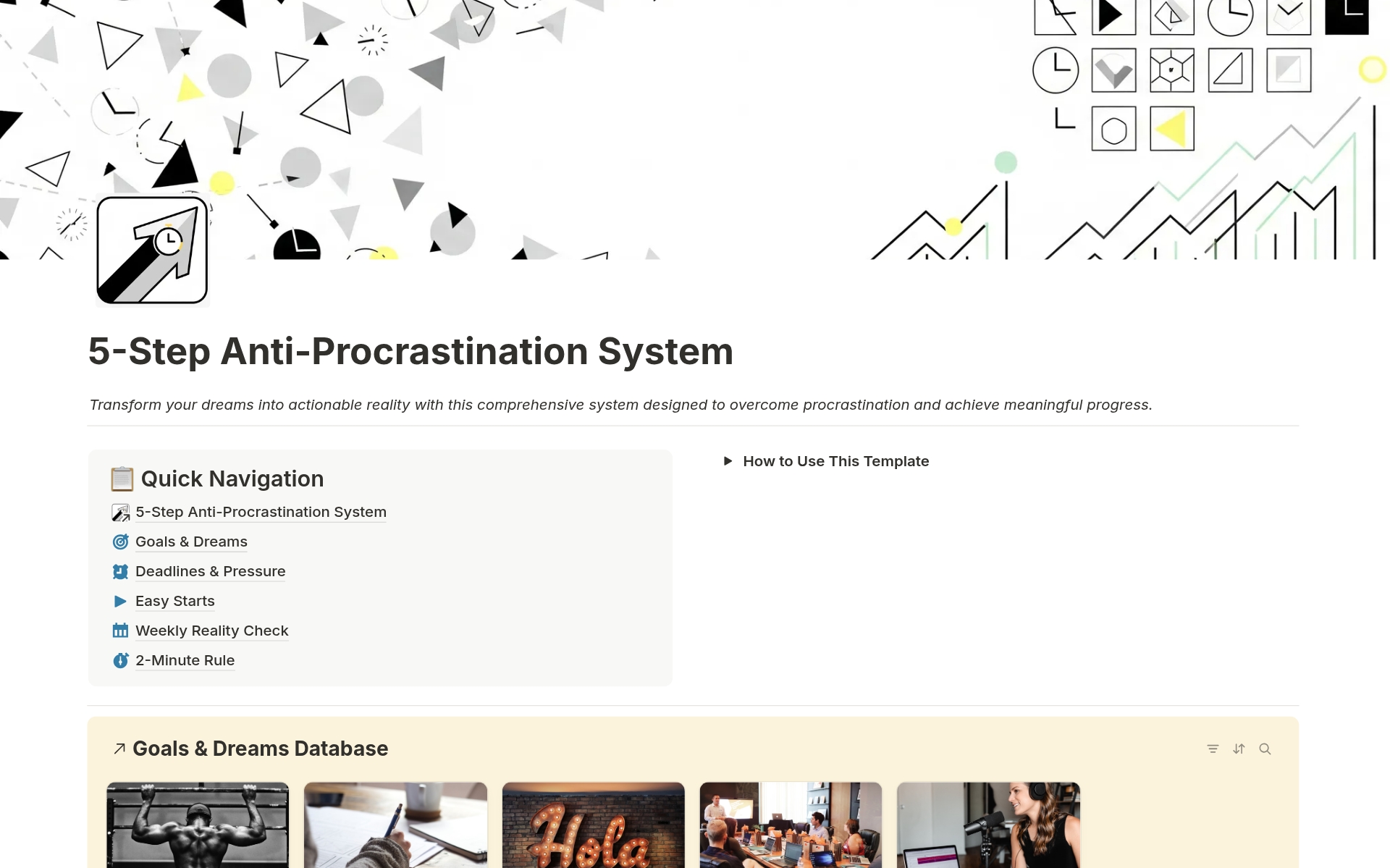
The 5-Step Anti-Procrastination System works on the mechanics of that mismatch rather than scolding you for it. It turns the fog of “I should really…” into something small enough to actually start.
The problem it addresses
The usual advice — try harder, want it more — misunderstands the problem. We avoid tasks when they are unclear, distant, and large; willpower has surprisingly little to do with it. The resistance to starting is a feeling no amount of guilt dissolves. Telling a procrastinator to be more disciplined is like telling an anxious person to relax.
What actually moves things is reducing the friction of the first step until starting becomes almost involuntary. That is a design problem rather than a character flaw, and design problems have solutions.
What’s inside
A five-step method, each addressing a different cause of stalling:
- Clarify the Gap. Separate vague dreams from specific, doable actions — because you cannot start a fantasy, only a task.
- Create Urgency. Use deadlines and visible pressure to convert “someday” into “by Friday.”
- Lower Barriers. Build simple startup rituals that make beginning effortless rather than effortful.
- Stay Accountable. A weekly reality check to keep momentum honest and correct course before things drift.
- Start Small. The two-minute rule, breaking the first action down until resistance has nothing to push against.
Together they form a loop you can run on any stuck goal, not a one-time motivational push.
Who it’s for
Chronic and occasional procrastinators alike: people with goals that have sat untouched for months, anyone who knows what they should be doing and cannot seem to begin, anyone whose self-talk has curdled into guilt without producing action. It suits people willing to be honest in the weekly review.
It is built for the gap between intention and starting, rather than as a productivity maximizer for the already-driven.
A closing thought
The most useful reframe here is that momentum is something you engineer rather than wait to feel. You do not need to feel motivated to take a two-minute action, and a two-minute action started has a way of becoming twenty. Procrastination loses most of its power the moment the first step is small enough that refusing it feels absurd. This system is built around that single insight — that the way out of stuck is almost always smaller, more concrete, and closer than the size of the goal makes it look.