Free template
Art history has a way of staying frustratingly external — a wall of names, dates, and movements that never quite assembles into a story you can hold. You learn that Impressionism preceded Cubism, but the connective tissue, the why and the how, slips away by the next museum visit.
Art History Explorer is built to make that knowledge cohere. It turns scattered art appreciation into a connected, personal body of understanding — artists, artworks, movements, and museums, linked the way they actually were in life.
The problem it addresses
Most people encounter art history in fragments: a painting admired in a gallery, an artist mentioned in passing, a movement half-remembered from school. The fragments rarely connect, so the bigger picture — how a movement grew from its moment, how one artist answered another — never forms. Knowledge that does not connect does not stick.
There is also no good home for the learning. The insight you had in front of a painting, the artist you meant to study further, the connection you noticed — all of it evaporates without somewhere to capture and relate it.
What’s inside
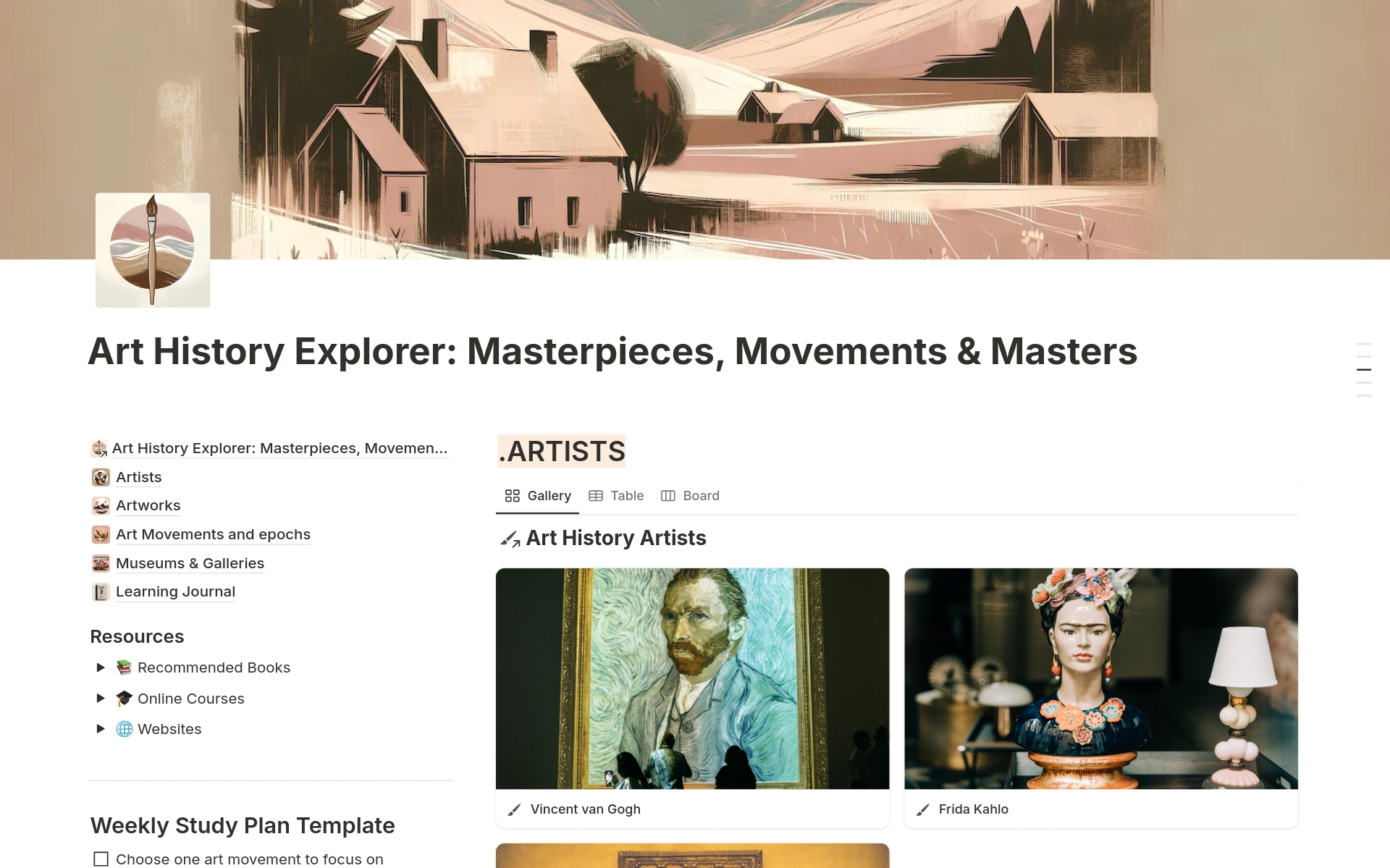
- Linked databases for Artists, Artworks, Art Movements and epochs, and Museums & Galleries — connected, so studying one naturally leads to the others.
- A Learning Journal for recording reflections, turning passive viewing into active understanding that accumulates.
- A weekly study plan that structures self-directed learning: choose a movement, study its key artists, analyze major works, read the context, reflect.
- A curated resource library — foundational books, online courses, and the best art websites — so you always know where to go deeper.
The relational structure is the heart of it: this is a knowledge web rather than a set of flat lists, so understanding compounds as it grows.
Who it’s for
Self-directed learners serious about understanding art rather than just admiring it: museum-goers who want their visits to add up, students seeking structure beyond a textbook, lifelong learners building real cultural literacy. It suits people who enjoy study as its own pleasure.
It gives your own exploration a structure instead of teaching a fixed curriculum, so curiosity becomes knowledge rather than a series of passing impressions.
A closing thought
There is a particular richness that art history offers once it clicks into place — a way of seeing that turns a painting from a pretty surface into a conversation with its time, its makers, and everything that came before. That depth comes from connecting facts rather than memorizing them — slowly, until the field becomes a landscape you can move through instead of a list you struggle to recall. Building that understanding is a quiet, lasting pleasure, and the kind that genuinely enriches how you see. This explorer is built to make that depth attainable, one connection at a time.