Free template
Buying a home is a decision made over months, in fragments, under pressure — and the fragments rarely sit in one place. Listings live in a browser, the agent’s number lives in a phone, the budget lives in a half-remembered conversation with a lender.
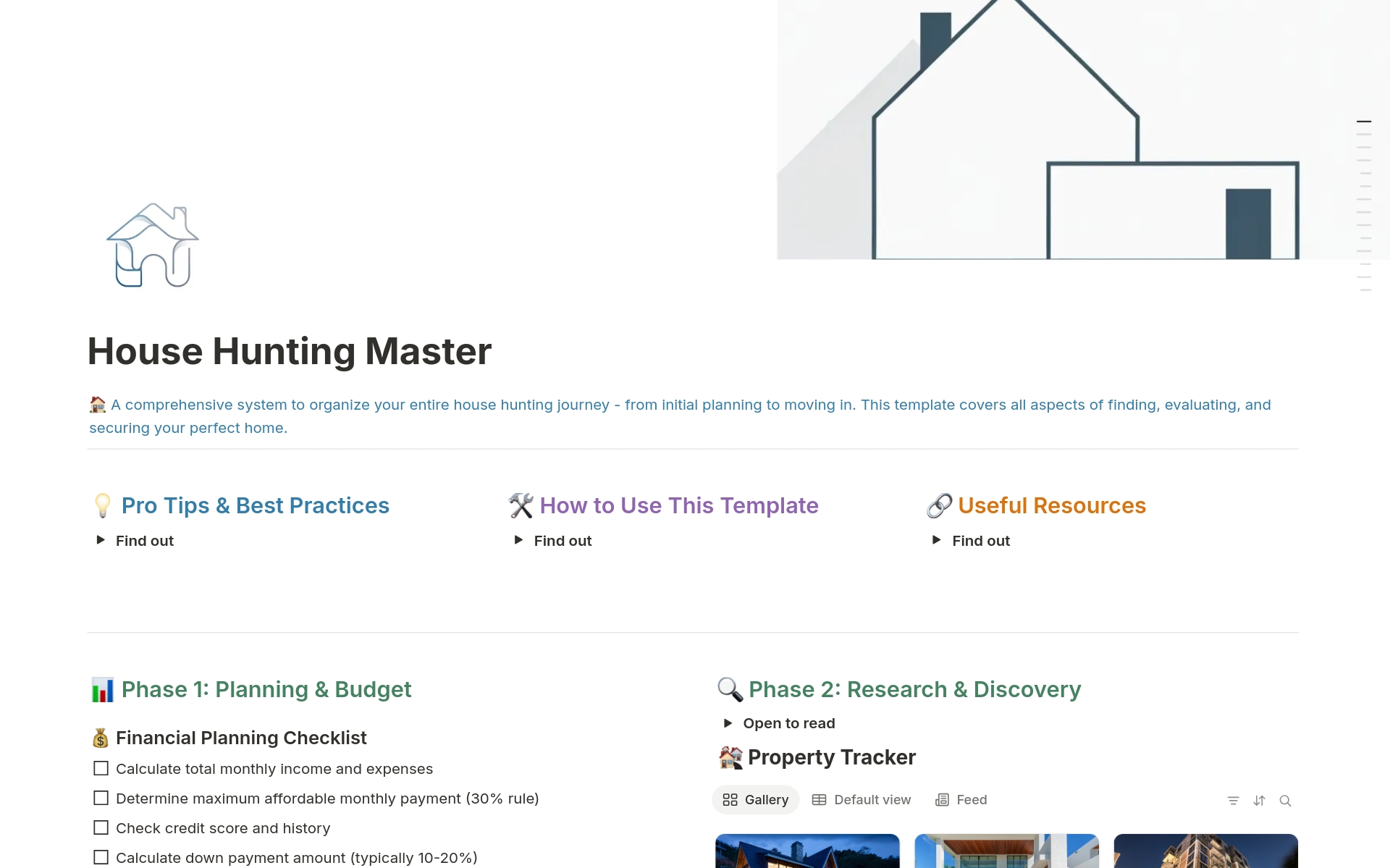
House Hunting Master pulls the whole journey into one structure, from the first budget question to the day the keys change hands.
The problem it addresses
Finding houses is the easy part of buying a home. The harder part is comparing them well, under emotional and financial strain, while the market moves faster than your notes. By the fifth viewing, the houses blur together. The good one from week two is now a vague memory, and the decision starts leaning on whichever property you saw most recently rather than which one actually fits.
There is also a sequencing problem. Pre-approval, inspections, contingencies, closing costs — each has its moment, and missing the moment is expensive. Most first-time buyers learn the order by paying for getting it wrong.
What’s inside
- A six-phase framework — planning and budget, research, viewing, making an offer, due diligence, and moving — each with a checklist that keeps the right work in the right order.
- Property Tracker. A database to log every house you consider, with ratings, notes, and photos, so comparison rests on a record rather than memory.
- Professional Contacts. Agents, lenders, and inspectors kept in one place, with the context of who does what.
- Practical guidance built in — the 30% affordability rule, what to inspect inside and out, what additional costs to expect — so the checklists carry reasoning, not just reminders.
It is built to be duplicated for a future move or shared with someone going through the same thing.
Who it’s for
First-time buyers who want a map through unfamiliar territory, and repeat buyers who would rather not rebuild their process from scratch each time. It suits people buying as a couple or a family, where keeping everyone looking at the same notes prevents a surprising amount of friction.
It does not give financial advice or replace an inspector. It organizes the journey so the professionals you hire are working from clear information.
A closing thought
There is a common belief that the right house announces itself — that you will simply know. Sometimes that happens. More often the certainty comes afterward, from having looked carefully enough to trust your own judgment. Keeping objective notes through a process this charged serves a narrow purpose: making sure emotion is informed. This template exists to keep the record clear while the feelings do their work.